Creative Asset Licensing: From Frantic to Friendly
[ Making brands our BFFs one font file at a time ]
If you're a creative professional using social media, it can be a challenge to make it an hour without reading someone's thoughts on branding. It's becoming increasingly likely that those conversations have seeped into broader spaces through "personal branding" or general marketing advice. Still, they're especially prevalent among creative professionals (and those who work in related fields or support roles alongside them).
Whether it's a marketer, social media manager, startup strategist, or designer, Branding As An Idea™ has gained a ton of attention and prominence as the go-to advice for business owners. If you're in spaces related to business building, you're probably seeing brand-building content every day – Top 10 lists, color palettes, type selections, or general taste-making tips and tricks. But seeing isn't always enough for the believing part. If you're a business owner (or one of the many that support and serve them), how do you know whom to listen to or take advice from?
Education, Empowerment, and Exploration
One of our guiding principles at ABLE Concepts is Education, Empowerment, and Exploration. I sincerely believe that context and insights help us make better decisions and move more confidently through life; that persistently seeking new information can create the space necessary to get curious and ask big questions. So, as a graphic designer turned brand strategist many years ago, I'm glad to see the conversation grow and mature, with more people on both the service-provider and business sides weighing in.
The growth and prominence of brand discussions and suggestions don't come without pitfalls, though. As less-tenured (or less experienced) designers, marketers, social media managers, et al. speak with authority on brand/branding, the message tends to get murkier, not less so. And with the onslaught of requests for greater AI adoption on the client side, the contextual language and expertise around good branding decisions become harder, not easier. Seeking information or advice is one thing, but trusting the accuracy and expertise is another entirely.
So where does that leave us?
We have more and louder voices being heard by more people interested in developing their brands.
The discussion around branding is wider than ever (more public or generic), but doesn't necessarily go deeper (more niche or tailored to a specific business's needs).
So many discussions happen online across social media where experience and expertise are challenging to flag correctly.
Democratized discussion and generalized advice about something as important as a business's brand can create quite a tenuous environment.
Business owners and brand representatives are forced into a guessing game of what's true and what isn't.
It's much more challenging to guarantee that the advice, suggestions, or direction blanketing the larger discussion is solid, legitimate, or foolproof.
Want to hear the real kicker? To take matters to another, more dire level: a majority of brand designers or strategists leading client brand work today still likely have blind spots in their understanding of the legal or financial liabilities associated with the creative brand decisions they're making.
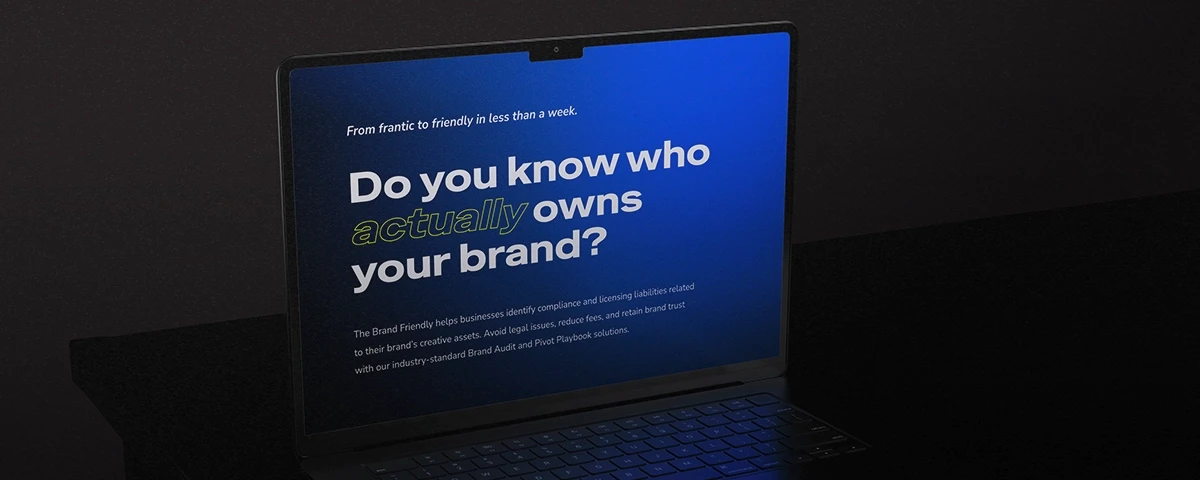
Do you know who actually owns your brand?
This is the primary question we ask our customers. We ask them to take a quick inventory of brand assets, creative files, contracts, and licenses. Businesses with visible, powerful, memorable brand presences. Businesses that have seven or eight-figure advertising or marketing budgets. Businesses that have been around for decades. Companies of all shapes, sizes, and market dominance…and so few of them can confidently answer those questions. It's why we believe The Brand Friendly is so necessary.
I'll let you in on a dirty little secret related to brand strategy, design, and provenance
For decades, the attribution and regulation of Intellectual Property (IP) for creative assets such as fonts, imagery, video, and original artwork have been incredibly challenging to govern and virtually impossible to track. So hard to track that there was little incentive to accurately estimate the costs or properly maintain the rights to creative assets.
The result? Many of us (myself included) tended to turn a blind eye... using fonts, images, code, etc., without properly licensing or purchasing those assets from the creators. The resources and information required to guide designers and brand managers through licensing accurately are confusing at best. And, when we consider the additional proliferation of generative AI-driven content (built on the stolen IP of existing creators' works), we're nearing terminal velocity on a world-sized problem that impacts creators and businesses alike.
This prompted us to ask some challenging questions with complex answers.
"Who is impacted and how?" explained in three simple categories:
Who owns what? – Illegal IP transfer and sharing on a mass scale only weakens the creative economy and branding.
Who is owed what? – The systemic removal of revenue-earning opportunities for creatives; possible lawsuits filed against businesses for improperly licensing assets from some of the world's largest, private-equity-backed font foundries and/or stock asset distributors.
How much do I owe? – An ever-growing, chaotic mess of licensing, fees, and confusing resources that don't allow creators or customers to accurately track and maintain their brand licensing assets, allowing them to understand or own their brand experiences fully.
This is why we created The Brand Friendly
To help businesses protect their reputations, prevent violations, and manage their creative assets with confidence.
Nobody sets out to break licensing rules. But when files have been passed between teams, agencies, and vendors for years, it's easy to lose track of them all. And if you've ever been the unlucky recipient of a Cease & Desist letter over a licensing violation, you quickly realize just how messy the whole situation can become – shut down your brand, or immediately pivot into the unknown. Time, money, headaches, and heartaches…
The Brand Friendly strives to accomplish two primary goals:
Help companies track their issues, untangle what's still at risk, and build processes that protect their teams long after that initial panic fades.
Support and promote the well-being and livelihoods of artists, designers, and creative professionals who provide the world with an opportunity to use the things they've created.
Protect your brand for good.
It's simple, but not easy: Businesses deserve to own their brands outright, and creatives deserve to be properly compensated for their Intellectual Property. Resolve licensing violations fast, and regain lasting control over your content and contracts.
Visit The Brand Friendly to learn more and get the process started.
Creative Asset Licensing: From Frantic to Friendly
[ Making brands our BFFs one font file at a time ]
If you're a creative professional using social media, it can be a challenge to make it an hour without reading someone's thoughts on branding. It's becoming increasingly likely that those conversations have seeped into broader spaces through "personal branding" or general marketing advice. Still, they're especially prevalent among creative professionals (and those who work in related fields or support roles alongside them).
Whether it's a marketer, social media manager, startup strategist, or designer, Branding As An Idea™ has gained a ton of attention and prominence as the go-to advice for business owners. If you're in spaces related to business building, you're probably seeing brand-building content every day – Top 10 lists, color palettes, type selections, or general taste-making tips and tricks. But seeing isn't always enough for the believing part. If you're a business owner (or one of the many that support and serve them), how do you know whom to listen to or take advice from?
Education, Empowerment, and Exploration
One of our guiding principles at ABLE Concepts is Education, Empowerment, and Exploration. I sincerely believe that context and insights help us make better decisions and move more confidently through life; that persistently seeking new information can create the space necessary to get curious and ask big questions. So, as a graphic designer turned brand strategist many years ago, I'm glad to see the conversation grow and mature, with more people on both the service-provider and business sides weighing in.
The growth and prominence of brand discussions and suggestions don't come without pitfalls, though. As less-tenured (or less experienced) designers, marketers, social media managers, et al. speak with authority on brand/branding, the message tends to get murkier, not less so. And with the onslaught of requests for greater AI adoption on the client side, the contextual language and expertise around good branding decisions become harder, not easier. Seeking information or advice is one thing, but trusting the accuracy and expertise is another entirely.
So where does that leave us?
We have more and louder voices being heard by more people interested in developing their brands.
The discussion around branding is wider than ever (more public or generic), but doesn't necessarily go deeper (more niche or tailored to a specific business's needs).
So many discussions happen online across social media where experience and expertise are challenging to flag correctly.
Democratized discussion and generalized advice about something as important as a business's brand can create quite a tenuous environment.
Business owners and brand representatives are forced into a guessing game of what's true and what isn't.
It's much more challenging to guarantee that the advice, suggestions, or direction blanketing the larger discussion is solid, legitimate, or foolproof.
Want to hear the real kicker? To take matters to another, more dire level: a majority of brand designers or strategists leading client brand work today still likely have blind spots in their understanding of the legal or financial liabilities associated with the creative brand decisions they're making.
Do you know who actually owns your brand?
This is the primary question we ask our customers. We ask them to take a quick inventory of brand assets, creative files, contracts, and licenses. Businesses with visible, powerful, memorable brand presences. Businesses that have seven or eight-figure advertising or marketing budgets. Businesses that have been around for decades. Companies of all shapes, sizes, and market dominance…and so few of them can confidently answer those questions. It's why we believe The Brand Friendly is so necessary.
I'll let you in on a dirty little secret related to brand strategy, design, and provenance
For decades, the attribution and regulation of Intellectual Property (IP) for creative assets such as fonts, imagery, video, and original artwork have been incredibly challenging to govern and virtually impossible to track. So hard to track that there was little incentive to accurately estimate the costs or properly maintain the rights to creative assets.
The result? Many of us (myself included) tended to turn a blind eye... using fonts, images, code, etc., without properly licensing or purchasing those assets from the creators. The resources and information required to guide designers and brand managers through licensing accurately are confusing at best. And, when we consider the additional proliferation of generative AI-driven content (built on the stolen IP of existing creators' works), we're nearing terminal velocity on a world-sized problem that impacts creators and businesses alike.
This prompted us to ask some challenging questions with complex answers.
"Who is impacted and how?" explained in three simple categories:
Who owns what? – Illegal IP transfer and sharing on a mass scale only weakens the creative economy and branding.
Who is owed what? – The systemic removal of revenue-earning opportunities for creatives; possible lawsuits filed against businesses for improperly licensing assets from some of the world's largest, private-equity-backed font foundries and/or stock asset distributors.
How much do I owe? – An ever-growing, chaotic mess of licensing, fees, and confusing resources that don't allow creators or customers to accurately track and maintain their brand licensing assets, allowing them to understand or own their brand experiences fully.
This is why we created The Brand Friendly
To help businesses protect their reputations, prevent violations, and manage their creative assets with confidence.
Nobody sets out to break licensing rules. But when files have been passed between teams, agencies, and vendors for years, it's easy to lose track of them all. And if you've ever been the unlucky recipient of a Cease & Desist letter over a licensing violation, you quickly realize just how messy the whole situation can become – shut down your brand, or immediately pivot into the unknown. Time, money, headaches, and heartaches…
The Brand Friendly strives to accomplish two primary goals:
Help companies track their issues, untangle what's still at risk, and build processes that protect their teams long after that initial panic fades.
Support and promote the well-being and livelihoods of artists, designers, and creative professionals who provide the world with an opportunity to use the things they've created.
Protect your brand for good.
It's simple, but not easy: Businesses deserve to own their brands outright, and creatives deserve to be properly compensated for their Intellectual Property. Resolve licensing violations fast, and regain lasting control over your content and contracts.
Visit The Brand Friendly to learn more and get the process started.